Colour Drenching in a Period House
Colour drenching means using one colour across the walls, the woodwork, often the ceiling, sometimes the radiators. It is the opposite of the feature wall. Instead of one bold surface and three nervous ones, the room is wrapped. People think it is dramatic. Done properly in a period house, it is often calmer than white walls with gloss skirting.
Victorian and Edwardian rooms are full of lines: picture rails, cornicing, architraves, panelled doors. Pick them out in brilliant white and you draw a diagram of the architecture. Drown them in the same hue as the wall and the plaster starts to read as modelling, like it did when the house was built. The decoration becomes shadow and light, not a contrast stripe.
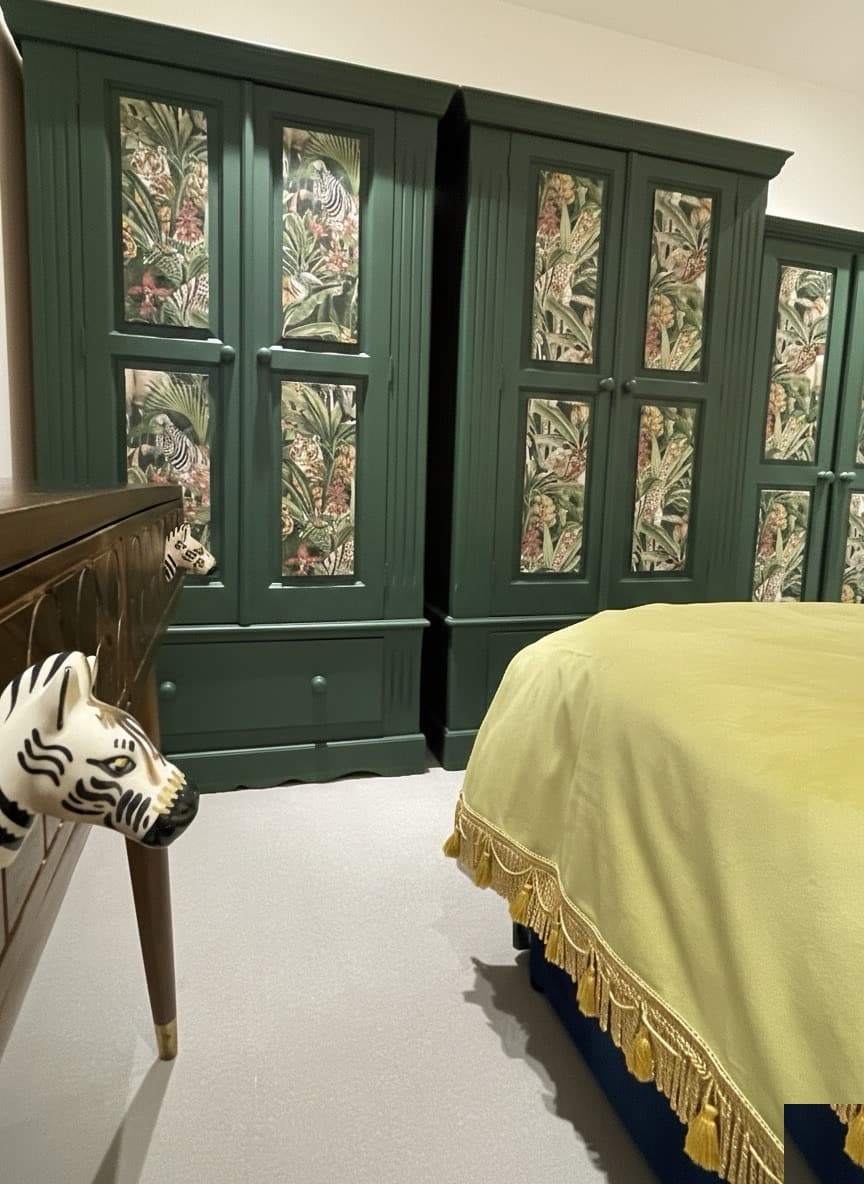
It works especially well in smaller rooms and in rooms with a lot of joinery. A bedroom with fitted wardrobes, a hallway with doors on three sides, a dining end that feels chopped up by frames. One colour lets the furniture and the fireplace take the attention. I have used deep forest on wardrobes and walls in a South London bedroom so the jungle-print panels and the brass could sit in a single atmosphere instead of fighting a cream box.
You do not have to go dark. An earthy pink, a putty, a green that is almost grey: drenching in a quiet colour is still drenching. The commitment is the continuity, not the saturation. Where I do go dark, I go all the way. A single navy wall in a small room points at the size of the space. Four walls and a ceiling in navy, with warm lamps, recede.
Finish matters. Dead flat or a soft matt on walls, a slightly more durable eggshell on woodwork in the same colour, so fingers do not destroy the door in a year. Match the radiators. Leave the ceiling white only if you have a reason, a beautiful rose you want to float, or a very low room that needs the extra bounce of light.
Samples on all the surfaces, not one tester pot on a wall. Look at them in the bay at nine in the morning and at the chimney at dusk. Period houses change temperature of light from front to back. The colour has to survive both.
If you have been told to keep the woodwork white because that is what period homes do, treat that as a habit, not a rule. The original decorative schemes were often much more saturated than a 1990s Magnolia refresh. Drenching is one way of giving those rooms their gravity back. If you want a hand choosing the colour and how far to take it, that is exactly what a consultation is for. I have written separately about dark paint in small rooms. This is the next step: not just dark, but complete.