How to Design a Victorian Terrace Living Room
A Victorian terrace living room is not a blank box, and that is the gift. You usually have a bay, a chimney breast with alcoves either side, high-ish ceilings, and a plan that is deeper than it is wide. Treat those things as the structure of the scheme, not as problems to disguise.
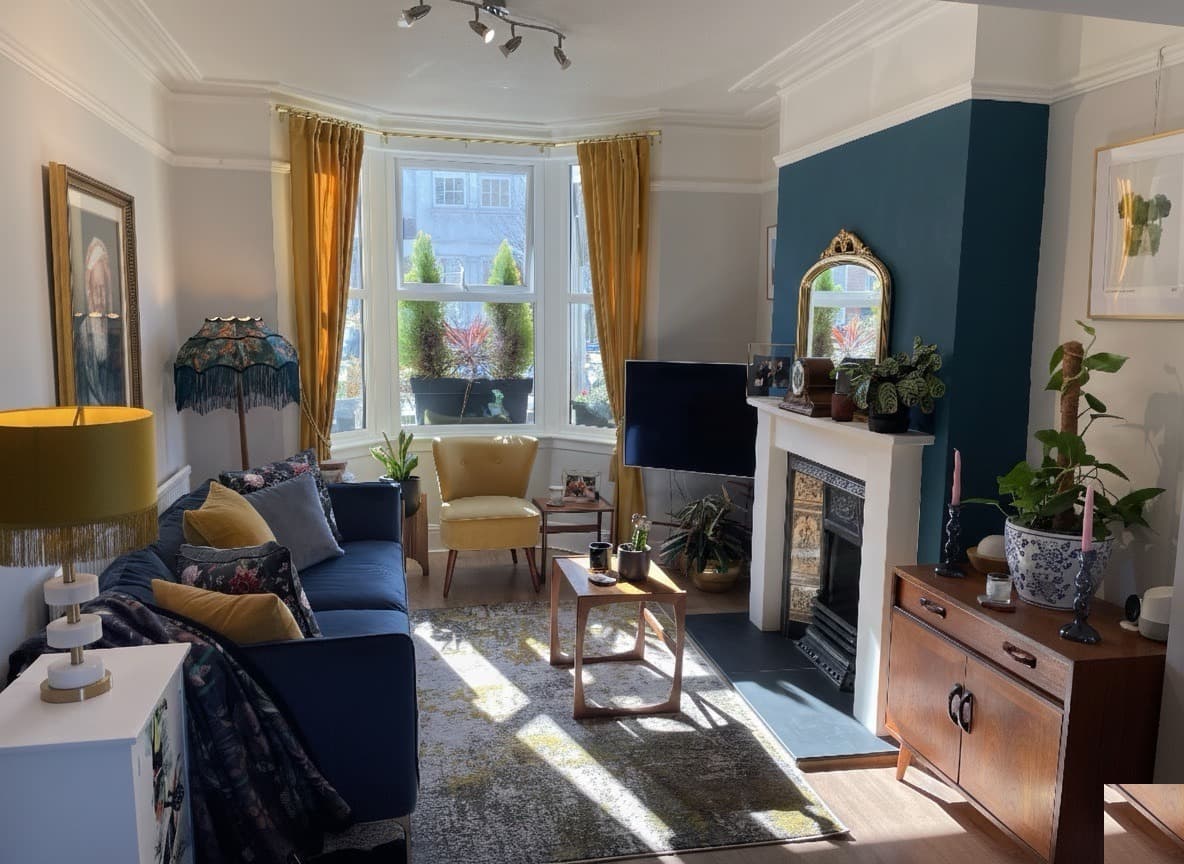
Start with the fireplace. It is already the centre of the room. Restore it if you can. Give it a wall colour that makes the marble or the tiles register, rather than a timid contrast strip. In an Addiscombe terrace I used a deep teal on the chimney breast, brought the original fire back to life, and hung a gold mirror so the bay and the fire talked to each other. The rest of the room could then be warmer and quieter, because the architecture was doing the drama.
The bay wants a job. It is not leftover space for a dying plant. A window seat, a pair of chairs, or a table that can take a lamp and a book. Let the curtains be generous. Victorian windows were made for fabric with a bit of weight. Skimping on the drop makes the whole elevation look nervous.
Alcoves are for joinery or for pieces with presence, not for dumping the television and hoping. A teak console, a pair of lamps, shelves that stop short of the cornice so the plaster can still read. If the television has to live here, treat it as one object among others, not as the altar.
Furniture scale is where most terrace living rooms go wrong. An oversized corner sofa stuffed into a narrow plan makes the bay feel like a corridor. Choose a sofa that leaves air at the chimney and a route to the window. Then add a second sit: an armchair in mustard, a stool, something with a different height so the room is not one long upholstered lump.
Colour should follow the light. These rooms often run front to back with a wall between, or they have been opened through. Front rooms can take depth, navy, forest, a brown that is almost plum. If the space is open to the dining end, keep a thread of the same palette so you do not get two different houses in one. Mustard against teal, navy velvet against warm timber: contrast, not clutter.
Lighting is not the centre rose. Add a chandelier or pendant if the ceiling can take jewellery, then lamps at sitting height. The Addiscombe living room only came alive in the evening when the crystal and the floor lamps were doing the work the old spotlights never could.
You do not need to fake a country manor. You need to let a Croydon or South London terrace be itself: a bit formal at the front, a bit lived-in once you sit down, with colour and antiques and a fire that looks as if someone might actually light it. If the room has been beige for a decade, that is the brief. I would rather start there than with a catalogue of trends.